De La Soul’s New Era: Inside Cabin In The Sky and the Legacy of Dave
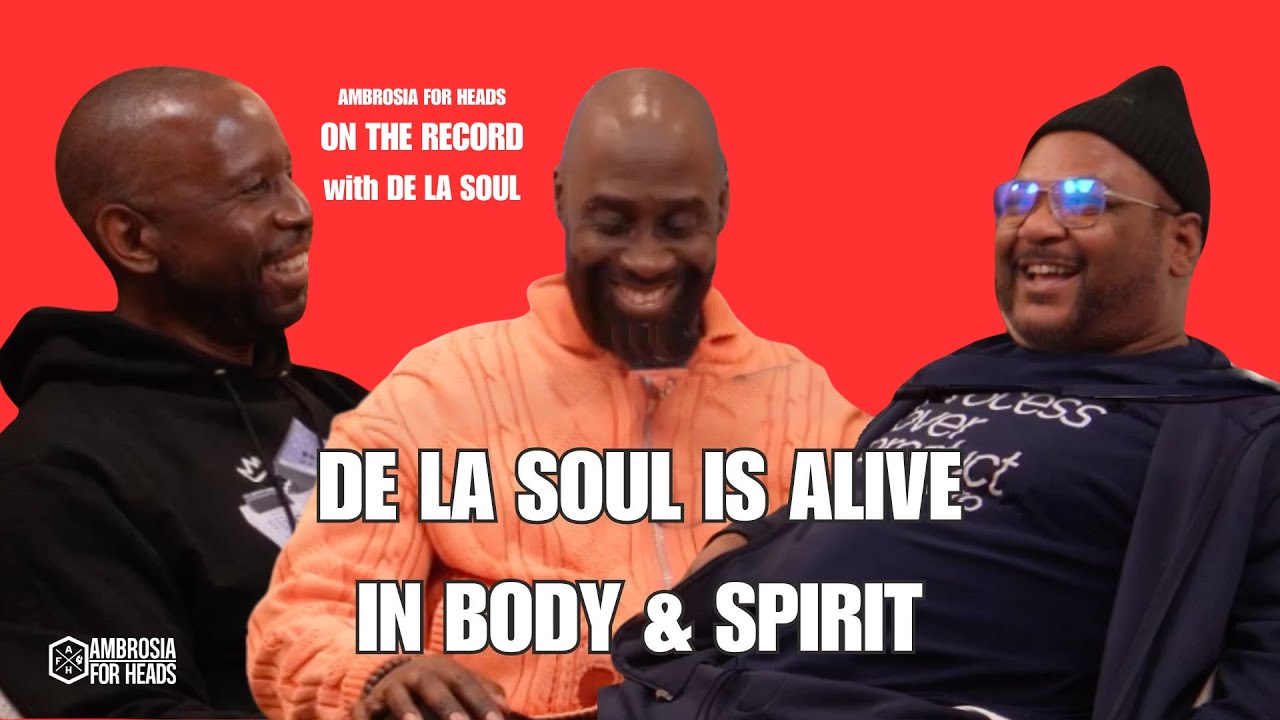
For more than three decades, De La Soul has occupied a singular space in Hip-Hop. Never fully inside the mainstream, never outside the culture, the group built a legacy rooted in curiosity, humor, and emotional intelligence long before those traits were widely rewarded. In the debut episode of Ambrosia For Heads’ long-form interview series ON THE RECORD, Posdnuos and Maseo sit down with AFH founder Reggie Williams for a conversation that feels less like promotion and more like reflection.
The discussion spans their latest album, Cabin In The Sky, the enduring presence of the late Dave “Trugoy the Dove” Jolicoeur, and the realities of aging inside a genre that has often struggled to honor growth. Cabin In The Sky builds on De La Soul’s long history of collaboration with artists like Nas, Raekwon, Ghostface Killah, DJ Premier, and Pete Rock, but the focus here is inward rather than retrospective.
The Spirit of Dave and the Meaning of Cabin In The Sky
Although Dave Jolicoeur passed in 2023, his creative fingerprint is deeply embedded in Cabin In The Sky. Pos and Maseo describe his presence not as absence, but as guidance. The album’s title reflects that transition, signaling continuity rather than closure.
Dave produced the album’s opening track, “YUHDONTSTOP,” and helped shape the emotional tone of the project. As Maseo explains, Dave was still “navigating this thing from the spiritual realm,” even as the group worked through unfamiliar emotional terrain. Posdnuos echoes that sentiment: “After I lost him, I felt like he was there. At times, when I go to bed I feel like he’s there or he’s trying to relay something, so I really tapped into that.”
Rather than framing the album as a memorial, De La Soul treats it as a living extension of a shared history, grounded in decades of trust and creative shorthand.
The Hidden Dream Sequence Beneath the Album
Pos reveals that Cabin In The Sky contains a hidden dream sequence that rewards listeners who engage with the album as a complete work. “The cabin talk, it’s really supposed to be like me dreaming,” he explains. He points to the opening roll call featuring Giancarlo Esposito as a narrative device: “It’s really like a dream and he mentions Dave and it’s like me waking up. Dave is saying ‘ya don’t stop,’ and so I wake up to his voice and his voice is the catalyst to my day, picking me up to do what I gotta do.”
The concept reflects an era where albums were designed to be lived with, not skimmed, reinforcing De La Soul’s long-held belief that sequencing and intention still matter.
Hip-Hop, AI, and the Line Between Tool and Threat
One of the episode’s most revealing moments comes through Dave Jolicoeur’s perspective on artificial intelligence. His view is neither alarmist nor dismissive.
“I’ll be honest in being still conflicted because of the era we come from,” Dave says. “We’ve always embraced technology. But I do see the long-term damage.”
For Dave, the concern is not experimentation, but extraction. He likens AI to a “kiosk for music,” where creative DNA is absorbed and repurposed at scale. “We’re feeding it our DNA,” he explains.
At the same time, he acknowledges why artists of his generation are drawn to it. “Us as creators, especially the era that we come from, we’re going to push the creative boundaries,” he says, likening AI’s appeal to the early days of sampling.
But perspective shifts with time. “My 20-year-old self wouldn’t have seen what my 55-year-old self sees,” Dave reflects. What once felt like an exciting new toy now registers as something far more powerful.
His conclusion is precise. AI is a tool, not a replacement. Something to be used intentionally, not something to make the music itself.
Growth, Accountability, and What Maturity Sounds Like
Beyond music, the interview touches on faith, parenting, mental health, and accountability. In one of the episode’s most striking moments, Maseo offers a public apology to Waka Flocka Flame, acknowledging past misunderstandings and the importance of correction.
The exchange reflects a broader theme running through the conversation: growth as an active process. What becomes clear is that De La Soul is not interested in being preserved as a moment in time. Posdnuos and Maseo speak as artists who are still learning, still questioning, and still engaged with the present.
In a culture that often struggles to imagine Hip-Hop beyond youth, they offer a different model, one where evolution is not a departure from authenticity, but its continuation.
Watch ON THE RECORD episodes with De La Soul, Erick Sermon, Your Old Droog, and Sean C on Ambrosia For Heads’ YouTube channel.