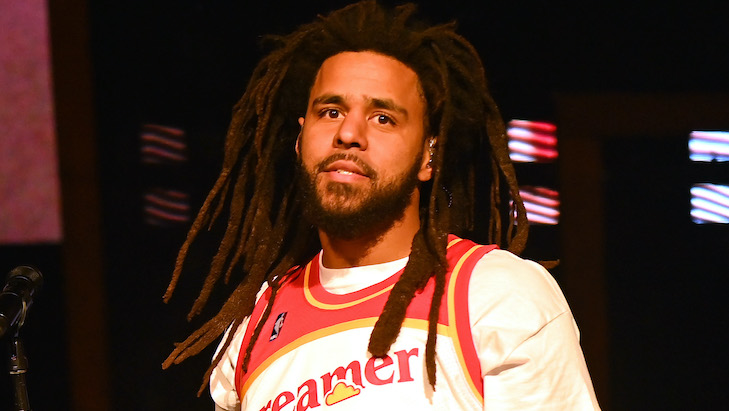
Why J. Cole Is The Tim Duncan Of Hip-Hop
With the recent release of J. Cole’s album The Fall-Off, the inevitable conversation about where he ranks among his peers Kendrick Lamar and Drake has resumed. For many, Cole’s status was diminished after he infamously ducked out of the battle between the other two MCs, but Ambrosia For Heads believes the demotion of Cole began long before that.
In an episode of AFH’s podcast, What’s The Headline, from 2021 Ambrosia For Heads founder Reggie Williams and Editor-in-Chief Jake Paine examined the state of the so-called “Big Three.” While public attention continues to orbit the friction between Drake and Kendrick Lamar, the conversation took a different turn.
The argument was direct: J. Cole may be the most technically complete MC of the era.
The comparison? Tim Duncan.
The Fundamentalist
“J. Cole is the Tim Duncan of Hip-Hop,” Reggie Williams says during the episode. “He is able to do anything Kendrick Lamar and Drake can do, but he doesn’t always get the props for it because he doesn’t do it with the same level of theater. He just goes out there, puts up 20 and 10, and wins the game.”
The analogy fits.
Like Duncan, Cole rarely relies on spectacle. His dominance shows up in execution: breath control, rhyme density, pacing, narrative clarity. The fundamentals.
Jake Paine adds another layer. “He represents intelligent people who grew up harshly,” Paine notes, pointing to Cole’s ability to merge high-level lyricism with grounded, lived storytelling.
That combination is easy to underestimate. It rarely goes viral. But it ages well.
“Heaven’s EP” and Intentional Timing
The discussion was sparked by “Heaven’s EP,” Cole’s remix of Drake’s “Pipe Down.” Released during the early stages of what became his celebrated feature run, the track felt like a reminder.
“J. Cole is very intentional about releasing singles outside of albums,” Reggie explains. “With ‘Heaven’s EP,’ he wasn’t just dropping a freestyle; he was staking his claim as Hip-Hop’s best MC. He was reminding the Grammy Awards and the industry that The Off-Season wasn’t a fluke, it was a standard.”
The key word is intentional.
Cole rarely moves impulsively. Even his quietest releases often serve a larger narrative. The feature run that followed reinforced that idea, with Cole approaching each guest verse like a proving ground.
Comparing the Big Three
The episode also explored how Drake, Kendrick Lamar, and J. Cole question themselves, and how those insecurities shape their music.
Drake wrestles publicly with status and relationships.
Kendrick interrogates morality, responsibility, and his role as a cultural voice.
Cole’s doubts are more technical. Is the fundamental approach enough? Is mastery without spectacle enough?
“Is J. Cole the best MC between him, Kendrick, and Drake?” Jake Paine asks. “When you look at the raw skill—the breath control, the multi-syllabic rhyme schemes, the ability to tell a story while still keeping a club bounce—Cole might actually be the most well-rounded of the three.”
Reggie points to a moment on tour when Drake told Cole directly that he is “one of the greatest rappers to ever touch a mic.” Even within the circle, the respect is there.
The Respect Gap
Despite accolades, Cole often ranks third in public debate. Kendrick receives the “artist” crown. Drake dominates commercially.
So why does Cole sit behind them in consensus lists?
Reggie suggests it’s narrative.
“He doesn’t have the polarizing ‘anti-hero’ energy of Drake, and he doesn’t have the ‘reclusive genius’ energy of Kendrick,” Reggie says. “He’s just the guy in the gym working on his jump shot. But if you look at the ‘Heaven’s EP’ performance, he’s showing that he can take any beat and out-class anyone on it.”
Drama generates headlines. Fundamentals generate rings.
Positioning for The Fall-Off
The conversation originally aired before the 2024 escalation between Drake and Kendrick and before Cole stepped back from that public exchange. In retrospect, the Tim Duncan comparison feels even more precise.
Duncan never chased theatrics. He chased consistency.
Cole’s choice to step away from spectacle in favor of longevity reinforces that parallel. The focus remains on the craft.
As excitement about The Fall-Off endures, the question lingers: Is the quiet giant actually setting the standard?
If the fundamentals still matter — rhyme structure, breath control, storytelling, composure — the answer may already be clear.
Cole may not generate the loudest headlines.
But the work continues to speak.